
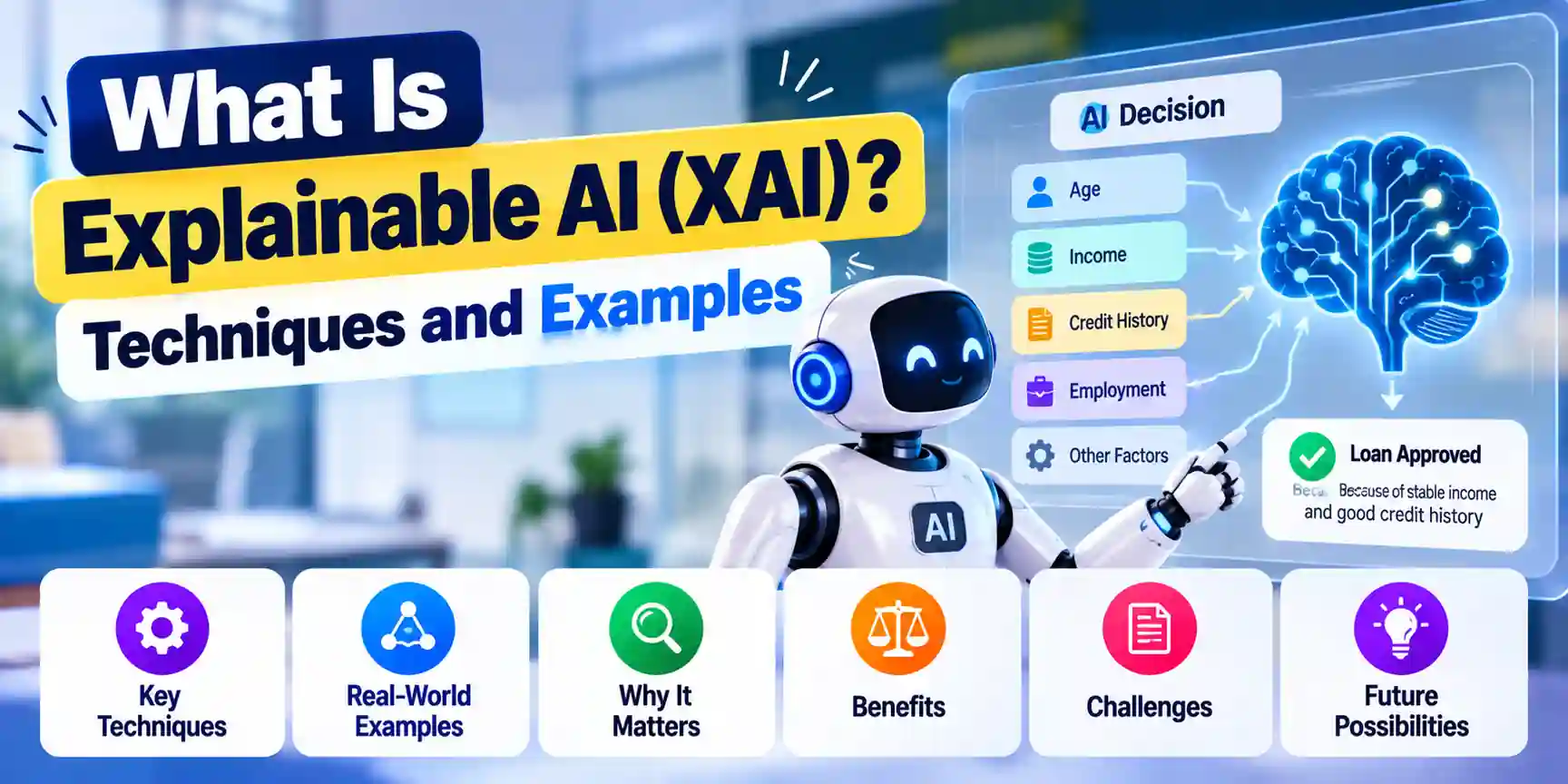
What Is Explainable AI?
Explainable AI (XAI) is a set of methods that show, in terms a person can follow, why an AI model produced a particular output. It turns a bare answer such as "loan declined" into a reason such as "declined mainly because of a high debt-to-income ratio and a short credit history."
Many high-performing models, especially deep neural networks and large language models, are hard to inspect from the outside. People see the input and the result but not the reasoning in between. Explainable AI tries to close that gap so that developers can debug models, users can trust or challenge decisions, and organizations can meet legal duties.
In short: explainable AI does not always make a model simpler. It adds a layer that describes which inputs mattered, how much they mattered and what would have changed the result.
Explainable vs interpretable AI
The two terms are often used as synonyms, but there is a useful difference.
- Interpretable models are understandable by design. A short decision tree or a linear regression shows its logic directly.
- Explainable AI usually refers to techniques applied after training to describe a complex model that is not readable on its own.
In practice, teams often choose an interpretable model when the stakes are high and the data allows it, and add explanation tools when they need a more complex model.
Why Do AI Models Need Explaining?
Models become hard to explain as they gain accuracy on messy, real-world data, and explainable AI exists to recover the reasoning that gets lost.
What makes a model opaque
- Scale: modern networks hold millions or billions of learned weights. No single weight maps to a human idea.
- Interactions: the model combines many features at once, so the effect of one input depends on the others.
- Learned features: an image model invents its own internal patterns rather than using labels a person defined.
- Ensembles: methods such as gradient-boosted trees average hundreds of trees, which hides the path behind any one result.
Why that matters
- Trust: doctors, loan officers and judges are reluctant to act on a result they cannot question.
- Fairness: explanations reveal when a model leans on a proxy for a protected trait, such as a postcode standing in for ethnicity.
- Debugging: they expose shortcuts. A well-known pattern is an image classifier that learns the background, such as snow, instead of the animal in the photo.
- Accountability: when a decision harms someone, an organization must show how it was made.
- Compliance: credit, hiring and medical rules in many countries require reasons for automated decisions.
Key Explainable AI Techniques
XAI techniques fall into two groups: global methods that describe a model's overall behavior and local methods that explain a single prediction. Most real projects use one of each.
1. SHAP (SHapley Additive exPlanations)
SHAP borrows Shapley values from game theory. It treats each feature as a player and measures how much that feature pushed a prediction up or down compared with the average prediction. The contributions always add up to the final output, which makes SHAP charts easy to read and compare.
- Use it for: tabular data such as credit, insurance and churn models.
- Watch out for: slow runtimes on large models, and misleading results when features are strongly correlated.
2. LIME (Local Interpretable Model-agnostic Explanations)
LIME explains one prediction at a time. It creates small variations of the input, watches how the model's output changes and fits a simple model to that local behavior.
- Use it for: quick explanations of text, image or tabular predictions from any model.
- Watch out for: results that can shift between runs because of random sampling.
3. Feature importance and partial dependence plots
Permutation importance shuffles one feature at a time and records how much accuracy drops. Partial dependence plots then show how the predicted outcome changes as that feature rises or falls.
- Use it for: a first, global view of which inputs a model relies on.
4. Counterfactual explanations
A counterfactual answers "what is the smallest change that would flip this decision?" For example: "the loan would have been approved with an income of $4,000 more per year."
- Use it for: customer-facing reasons, because they suggest a clear action.
5. Saliency maps and Grad-CAM
For images, these methods highlight the pixels or regions that most influenced the result, shown as a heat map over the picture.
- Use it for: checking whether a medical or vision model looks at the right part of an image.
6. Attention and mechanistic interpretability for LLMs
For language models, simple attention maps show which words the model weighed. Newer mechanistic interpretability research goes further, tracing the internal features and circuits a model uses to produce an answer.
- Use it for: research, safety testing and auditing model behavior.
- Watch out for: attention weights alone are not a reliable explanation of why a model answered as it did.
7. Inherently interpretable models
Sometimes the best explanation is a simpler model: a decision tree, a scorecard or a generalized additive model. These may give up a little accuracy in exchange for logic anyone can audit.
Explainable AI Techniques Compared (Including SHAP vs LIME)
SHAP gives more consistent, additive explanations, while LIME is faster and easier to apply to any data type; the table shows where every technique fits.
TechniqueScopeWorks withBest data typeMain strengthMain limitSHAPLocal + globalAny model (fast versions for trees)TabularConsistent, additive scoresSlow on large modelsLIMELocalAny modelText, image, tabularQuick and flexibleResults vary between runsPermutation importanceGlobalAny modelTabularSimple overviewMisleads with correlated featuresPartial dependence plotsGlobalAny modelTabularShows direction of effectHides individual differencesCounterfactualsLocalAny modelTabularActionable reasonsMany valid answers per caseSaliency maps / Grad-CAMLocalNeural networksImagesVisual heat mapCan look convincing yet be wrongMechanistic interpretabilityInternalNeural networks, LLMsTextExplains internal featuresEarly-stage, research-heavyInterpretable modelsWhole modelItselfTabularFully transparentMay lose some accuracy
Explainable AI Examples by Industry
Explainable AI matters most where a decision changes someone's money, health, job or freedom.
- Banking and lending: lenders use SHAP scores or reason codes to tell applicants the main factors behind a declined loan. Counterfactuals add a next step, such as reducing card balances.
- Healthcare: heat maps on X-rays and scans show radiologists which area a model flagged, so they can confirm or reject the finding rather than accept it blindly.
- Insurance: pricing teams check that premium models rely on driving history or claims, not on proxies that could discriminate.
- Hiring and HR: explanations reveal whether a screening model is favoring keywords linked to gender, age or school rather than skills.
- Fraud detection: analysts see which transaction features triggered an alert, which speeds up reviews and cuts false positives.
- Manufacturing: engineers learn which sensor readings drive a failure prediction, so they can fix the root cause instead of just reacting to alerts.
- Public sector: agencies that use risk scores for benefits or inspections need explanations to handle appeals fairly.
Explainable AI and Regulation in 2026
Laws rarely say "use SHAP," but several now require organizations to explain automated decisions, document how models work and keep a human able to step in.
- EU AI Act: high-risk systems, such as those used in hiring, credit and education, must be transparent enough for deployers to understand and oversee them. Under the Digital Omnibus that entered into force on 27 July 2026, these duties now apply from 2 December 2027 for stand-alone high-risk systems and 2 August 2028 for AI built into regulated products (CASRAI). Rules for general-purpose AI models have applied since August 2025.
- GDPR: people subject to significant automated decisions have rights to meaningful information about the logic involved and to contest the outcome.
- US credit law: under the Equal Credit Opportunity Act, lenders must give specific reasons when they deny credit, even if the decision came from a complex model.
- NIST AI Risk Management Framework: lists "explainable and interpretable" as one of the core traits of trustworthy AI and is widely used as a voluntary standard.
The delay in the EU gives teams more time, not an exemption. Building explanations into models now is cheaper than retrofitting them before a deadline.
Challenges and Limits of Explainable AI
Explanations are approximations of a model, not the model itself, so they need the same scrutiny as the predictions they describe.
- Fidelity: a simple explanation of a complex model may be clear but not fully accurate.
- Accuracy trade-off: switching to an interpretable model can cost some performance on images, audio or text.
- Manipulation: research has shown that models can be tuned to produce reassuring explanations while still behaving unfairly.
- Wrong audience: a SHAP chart helps a data scientist but confuses a customer. Each audience needs a different format.
- Cost: some methods are slow on large models and large datasets.
- LLM complexity: explaining a model with billions of parameters and open-ended outputs remains an active research problem.
Best practices
- Decide who the explanation is for before choosing a method.
- Prefer an interpretable model when it performs close to a complex one.
- Combine one global and one local method.
- Test explanations against known cases to check they hold up.
- Document models, data and explanation methods for audits.
Conclusion
Explainable AI turns opaque predictions into reasons people can check, question and act on. It does not replace good data or careful model design, but it makes errors and bias far easier to catch.
With rules in the EU, the US and elsewhere asking for clearer automated decisions, XAI skills such as using SHAP, LIME and counterfactuals are becoming part of the standard toolkit for data scientists, ML engineers and AI product teams.
FAQs
1. What is explainable AI in simple terms?
Explainable AI is AI that can show why it made a decision, for example by listing the factors that mattered most and how much each one counted.
2. What is the difference between black box AI and explainable AI?
Black box AI gives results without visible reasoning. Explainable AI adds methods that describe that reasoning, either by using a transparent model or by explaining a complex one after training.
3. What is the difference between SHAP and LIME?
SHAP uses game theory to assign each feature a consistent contribution that adds up to the prediction. LIME fits a simple model around one prediction. SHAP is more stable; LIME is usually faster and easier to apply.
4. Is explainable AI required by law?
Not by name in most places, but rules such as the EU AI Act, GDPR and US credit law require transparency, reasons for decisions or human oversight, which in practice need explainability.
5. Can large language models be explained?
Partly. Tools can show which parts of a prompt influenced an answer, and mechanistic interpretability research is mapping internal features. Fully explaining LLM behavior is still an open problem.
6. Does explainable AI reduce accuracy?
Adding explanation tools to an existing model does not change its accuracy. Switching to a simpler, interpretable model can reduce accuracy on some tasks, though on many tabular problems the gap is small.
Get a free marketing audit
See exactly where your SEO, ads and website are leaving money on the table.